
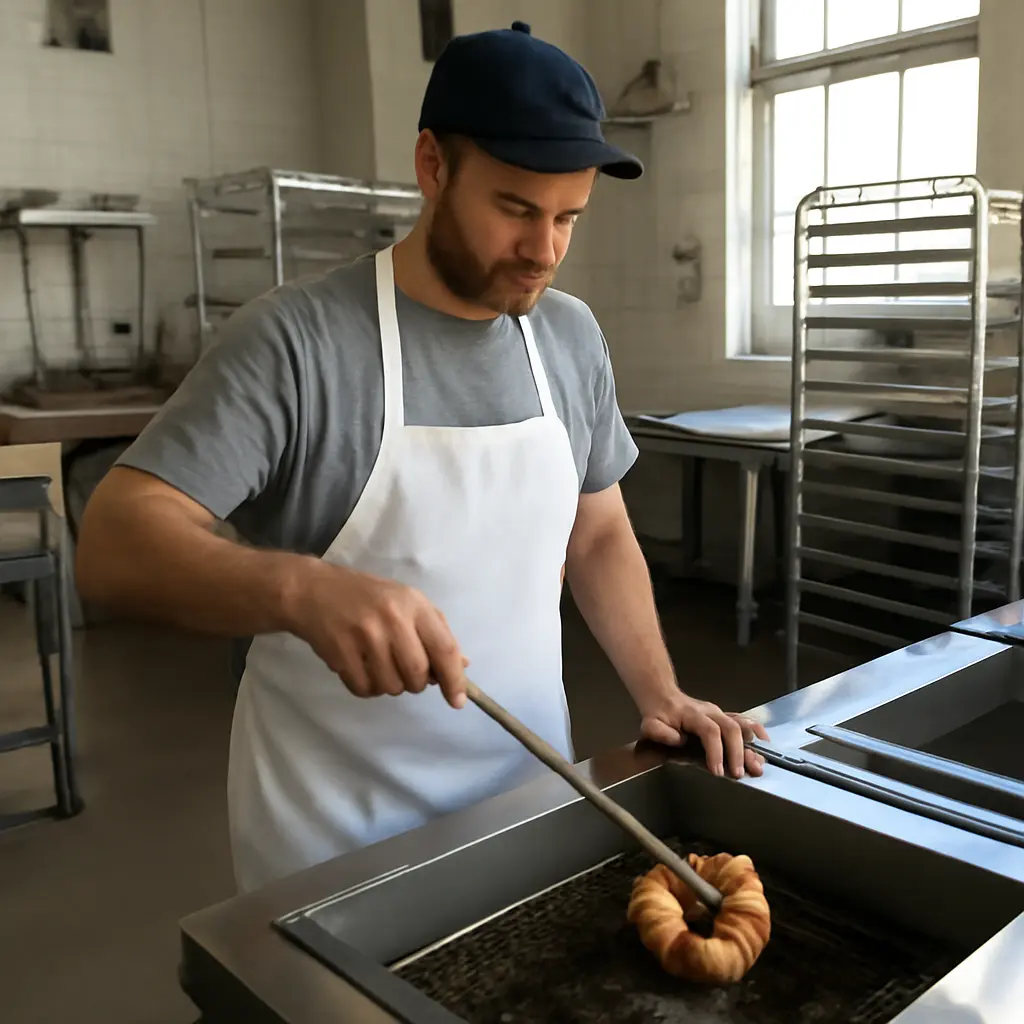
A cruller is a ridged, ring-shaped pastry whose texture and shape depend on what happens between mixing, piping, and frying. When crullers hit hot oil, heat sets their structure while moisture escapes as steam, producing a crisp exterior and a tender interior. The result depends on dough type, oil temperature, batch size, and timing—not simply on how long a pastry stays in the fryer. Understanding those steps explains why bakery workers watch the oil so closely, how different crullers behave, and what food-safety practices keep the process consistent.
Frying conditions shape cruller texture and color
A fryer is a vessel that transfers heat from hot oil to food. For crullers, that transfer has to cook the pastry’s interior while browning its surface without leaving it greasy or scorched. The Culinary Institute of America’s professional baking instruction describes frying as a high-temperature cooking method in which hot fat cooks food rapidly; the exact time and temperature vary by product and equipment.
Crullers are not one uniform dough. Yeast-raised crullers rely on fermentation and a lighter, breadlike crumb; cake-style crullers use a chemically leavened batter or dough; French crullers are commonly made from pâte à choux, a cooked dough that expands as steam forms during frying. These related pastry types may share a ring shape, but their moisture, structure, and frying behavior differ.
Oil temperature controls the first moments
Oil temperature is the heat level of the frying medium, measured with a suitable thermometer or fryer control. Many commercial doughnuts are fried around 350–375°F (177–191°C), though a bakery must follow a tested recipe and equipment guidance rather than treat that range as universal. Oil that is too cool slows crust formation, allowing more fat to enter the pastry; oil that is too hot can darken the outside before the center cooks.
When dough enters the fryer, its surface heats quickly. Moisture inside turns to steam and moves outward, while the dough’s starches and proteins set into a crust. The temperature then drops temporarily because the cooler dough absorbs heat. A worker who loads too many crullers at once can cause a larger temperature drop and uneven results, so batches are sized to suit the fryer.
Steam and dough structure create the crumb
Steam is water vapor produced as moisture in the dough heats. In pâte à choux, the dough is cooked before eggs are added, and its high moisture content helps create expansion during baking or frying. As the pastry sets, that expansion can leave an airy interior. A yeast-raised cruller gets much of its initial structure from fermentation before frying, while a cake-style version depends more on chemical leavening and its flour-and-liquid balance.
These differences explain why the same fryer setting does not guarantee the same result for every cruller. A delicate choux ring can puff and become light, while a denser cake-style ring may need a different handling and timing routine. The American Institute of Baking and professional baking texts emphasize that ingredient proportions, mixing, and process conditions all affect finished pastry quality.
Bakery handling determines how crullers fry
Fryer technique is the set of handling steps that moves a shaped pastry safely into hot oil, cooks it evenly, and removes it at the right point. In a bakery, those steps usually begin before the fryer is switched on: staff prepare consistent pieces, check the oil, and organize batches so the pastries do not crowd one another.
Piping, proofing, and portion consistency
Piping is the controlled shaping of soft dough through a pastry bag and nozzle. For French crullers, a star-shaped nozzle creates the ridges associated with the pastry; consistent ring size helps each piece cook at a similar rate. Yeast-raised crullers may be cut or deposited and then proofed, meaning they are allowed to rise before frying. Proofing time and dough temperature affect volume and handling, so bakery teams use recipe-specific standards rather than relying on appearance alone.
The pieces must also be transferred without collapsing or splashing. Some shops pipe onto small squares of parchment and lower them into the oil, then remove the paper once the dough releases. Whatever the method, uniform portions make it easier to judge cooking and reduce the risk of some crullers being pale while others become overdone.
Turning, draining, and finishing
Turning is the controlled flipping of a pastry so both sides brown. Workers may use a skimmer or fryer tool and watch for an even golden color, adequate expansion, and a cooked interior. Color alone is not a perfect doneness test: the correct time depends on the cruller’s size, dough, oil temperature, and fryer performance.
After frying, crullers are lifted above the oil to drain, often on a rack or absorbent surface. Draining lets excess surface oil run off before glazing or sugaring. A glaze is generally applied after the pastry has cooled enough to avoid becoming excessively thin or sliding off; serving temperature and the bakery’s recipe determine the finishing sequence.
Oil quality and food safety protect the batch
Frying oil quality refers to how well the oil retains its cooking performance and acceptable flavor as it is heated and reused. Repeated heating, food particles, oxygen, and moisture gradually break oil down. The U.S. Department of Agriculture advises keeping cooking oil from overheating and discarding it when it becomes foamy, unusually dark, thick, or rancid-smelling. Commercial bakeries use their own monitoring and replacement procedures to maintain product quality.
Temperature monitoring and fryer hygiene
A fryer’s display should be checked against the actual oil temperature, because controls and probes can be inaccurate or affected by placement. Crumbs and bits of dough should be removed according to the equipment’s safe operating procedure; burned particles can darken the oil and affect flavor. Staff should also avoid introducing water to hot oil, since water flashes into steam and can cause dangerous splattering.
The U.S. Food and Drug Administration Food Code provides the model framework many state and local food-safety rules draw upon. Its provisions address safe food handling, equipment, and sanitation in food establishments. The code is a model rather than a single nationwide restaurant rule, so bakeries must follow the requirements adopted by their own jurisdiction.
Hot-oil hazards and worker protection
Hot oil can cause severe burns, and splashes are especially likely when food is wet, dropped carelessly, or added to an overfilled fryer. The Occupational Safety and Health Administration’s general workplace-safety guidance supports training employees to use equipment safely, keep work areas orderly, and follow hazard-specific procedures. In practice, that means using suitable tools and protective equipment, keeping handles and walkways clear, and never moving or draining a fryer while its oil is dangerously hot.
What bakery workers look for in a finished cruller
A successful cruller is evaluated through several cues together: shape, color, surface texture, aroma, and interior crumb. The exterior should be cooked and appropriately browned for its style; the interior should match the intended texture, whether airy, tender, or more cake-like. A greasy feel, raw center, collapsed shape, or bitter flavor can point to problems with dough preparation, oil temperature, batch loading, or oil condition.
For example, if a batch emerges unusually pale and oily, a worker might check whether the oil temperature fell too far after loading or whether the fryer was set too low. If the outside darkens while the middle remains undercooked, the oil may be too hot, the pastries may be oversized, or the timing may be wrong. These are diagnostic clues, not automatic proof of a single cause, so experienced staff compare the batch with the bakery’s established recipe and process records.
A useful visual for training is a simple process chart showing dough preparation, shaping or proofing, frying, draining, and finishing, with temperature checks marked at fryer loading and recovery. Such a chart makes clear that quality is a chain of connected decisions rather than a single moment at the fryer.
Conclusion: Cruller frying is a controlled sequence
When crullers hit the fryer, heat sets their outer structure while steam and leavening help shape the interior. Oil temperature, dough type, portion size, batch loading, turning, and draining all influence the final pastry. Oil maintenance and safe handling matter just as much: they protect both the product and the bakery team.
For a closer look at the craft, compare how yeast-raised, cake-style, and pâte à choux crullers behave under a bakery’s tested procedures, and consult local food-safety rules before adapting a process. The best cruller is not produced by guesswork; it is the result of consistent dough preparation, careful frying, and attentive judgment at every step.
Sources: Culinary Institute of America, The Professional Chef, https://www.wiley.com/en-us/The+Professional+Chef%2C+9th+Edition-p-9781119299612; U.S. Department of Agriculture, Deep Fat Frying and Food Safety, https://www.fsis.usda.gov/food-safety/safe-food-handling-and-preparation/food-safety-basics/deep-fat-frying-and-food-safety; U.S. Food and Drug Administration, Food Code 2022, https://www.fda.gov/food/fda-food-code/food-code-2022; Occupational Safety and Health Administration, Recommended Practices for Safety and Health Programs, https://www.osha.gov/safety-management.