
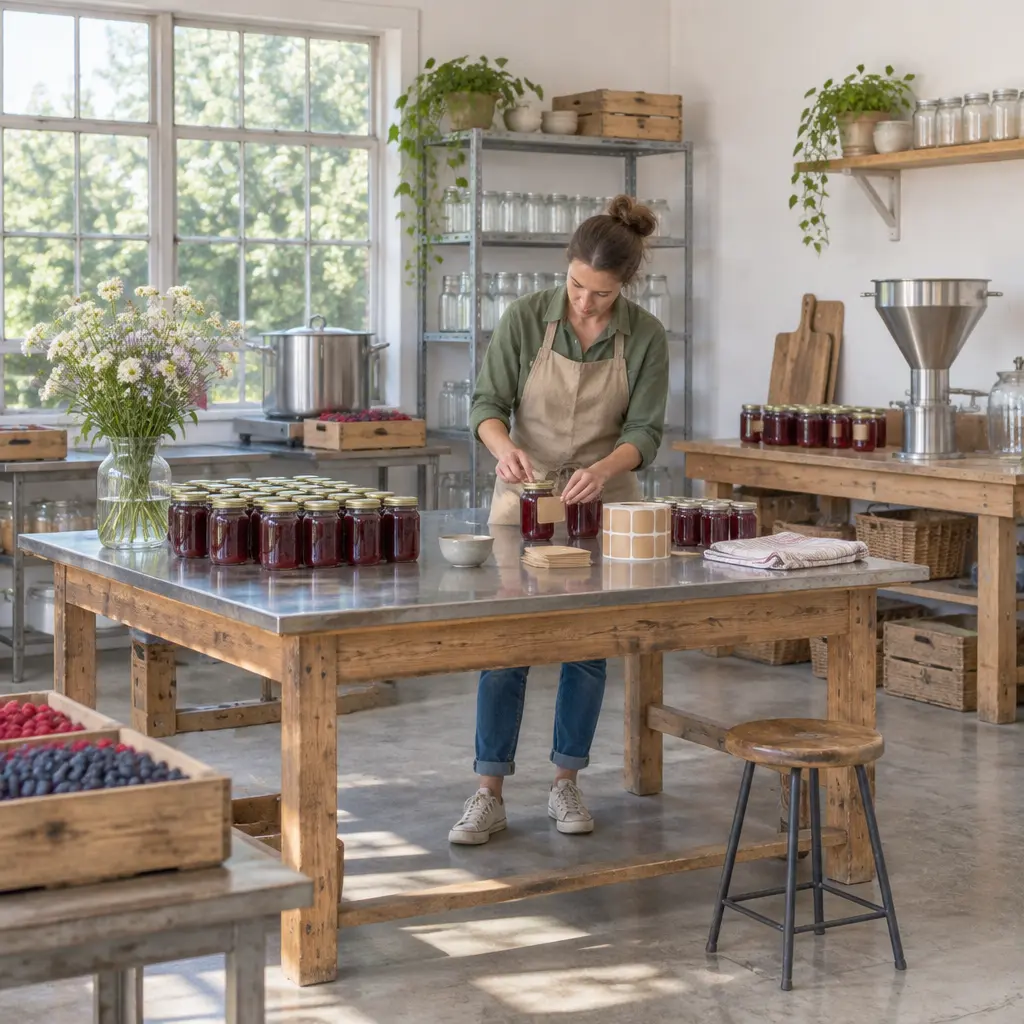
Handmade food and personal-care products are goods made in relatively small quantities through hands-on production, often with closer attention to ingredient selection and processing than a standardized, high-volume line can provide. Small-batch methods can make it easier for makers to trace ingredients, adjust recipes, and preserve distinctive qualities, but “handmade” and “small-batch” do not automatically guarantee purity, safety, or sustainability. Their value is strongest when craft is supported by transparent sourcing, consistent quality controls, and honest labeling. Those principles matter in a market where U.S. organic food sales reached $69.7 billion in 2023, according to the Organic Trade Association, and where consumers increasingly seek meaningful information about how products are made.
Small-Batch Production Defines Handmade Ingredient Integrity
Small-batch production describes making goods in limited, manageable runs rather than continuously manufacturing at industrial scale. There is no universal batch-size threshold: a bakery, soap studio, coffee roaster, and specialty condiment maker may each use the term differently. The useful distinction is operational. Smaller runs can allow a producer to inspect materials and finished goods more closely, document ingredient lots, and respond sooner when a supplier or recipe changes.
Ingredient integrity means that a product’s ingredients are identifiable, accurately represented, appropriately handled, and consistent with its stated quality or sourcing claims. The U.S. Food and Drug Administration (FDA) explains that food labels provide information such as ingredient lists and allergen disclosures to help consumers understand what a packaged food contains. In the United States, ingredients generally appear in descending order by weight, making the label an important starting point for evaluating a product—not proof by itself of how the ingredients were grown or processed.
The concept includes several related practices: direct or documented sourcing, careful handling, lot tracking, restrained processing where appropriate, and clear communication about limitations. These practices are relevant across handmade foods, beverages, cosmetics, and household goods, although requirements differ by product category. For example, food businesses must follow applicable food-safety rules, while cosmetic makers have separate obligations for product safety and labeling.
Traceable Sourcing and Ingredient Provenance
Traceable sourcing is the ability to identify where ingredients came from and how they moved through the supply chain. A maker may keep supplier invoices, farm or mill details, harvest dates, certificates, and receiving records. This information can support a specific claim—such as a named origin or certified organic status—and help isolate a problem if a batch is recalled.
The USDA Organic label offers a regulated example of provenance and production standards. The U.S. Department of Agriculture’s National Organic Program sets requirements for certification and handling, with limited exemptions for certain small operations. Organic certification does not mean that a food is inherently safer or more nutritious than a conventional equivalent; it indicates compliance with defined production and handling standards. Handmade producers should therefore distinguish certified claims from broader, less precisely defined terms such as “natural” or “farm-sourced.”
Batch Records and Process Control
Batch records connect a finished product to its ingredients, production date, method, and checks. In a small bakery, for instance, a record might identify flour and dairy lots, mixing time, oven settings, cooling conditions, and the finished batch code. In a skincare studio, corresponding records may track oils, fragrances, packaging, and sanitation steps.
This documentation matters because small-scale work is not exempt from food-safety obligations. The FDA’s Food Safety Modernization Act rules emphasize preventive controls and risk-based practices for covered food facilities, subject to applicable exemptions and modified requirements. The practical lesson is that craft and control should work together: a smaller operation may offer closer oversight, but it still needs repeatable procedures, sanitation, and corrective action when results fall outside expectations.
Ingredient Integrity Strengthens Handmade Product Quality
Ingredient integrity contributes to product quality when makers choose inputs for a clear purpose and preserve their useful characteristics through storage and production. Freshly milled grain, seasonal fruit, single-origin coffee, and carefully selected oils can affect aroma, flavor, texture, or performance. Small batches can make it easier to adjust recipes around natural variation, though they do not eliminate it: crop, climate, storage, and supplier changes can all alter raw materials.
The comparison with mass production is not simply “better versus worse.” Large manufacturers can invest in laboratory testing, specialized equipment, and formal quality systems. Small makers may benefit from shorter decision paths and closer sensory inspection. The strongest quality proposition depends on evidence—such as reliable sourcing, suitable testing, accurate labels, and consistent outcomes—rather than production scale alone.
Freshness, Seasonality, and Limited Runs
Seasonal production aligns a product with ingredients available at a particular time or place. A jam maker may produce a limited run when local berries are ripe, while a roaster may offer coffee from a particular harvest. These practices can create distinctive flavor and encourage closer relationships with suppliers, but “seasonal” does not automatically mean local, low-impact, or fresher at the point of purchase. Storage and transport still matter.
Shelf life should also be treated as a quality and safety question, not just a marketing detail. The FDA advises consumers to follow package storage directions and notes that date labels such as “best if used by” generally indicate quality rather than a universal safety cutoff, with certain exceptions and product-specific rules. Small producers should set shelf-life guidance appropriate to the product, validate it where necessary, and avoid implying that shorter runs alone guarantee freshness.
Minimal Processing and Honest Formulation
Minimal processing refers to limiting processing steps or additives while still making a product safe, stable, and suitable for use. It can be a meaningful formulation choice for products such as stone-ground nut butter or a simple soap, but it is not a universal measure of quality. Processing can also improve safety, consistency, and usability; pasteurization, for example, is an important control for many foods.
Clear formulation means explaining what a product contains without suggesting that unfamiliar ingredients are harmful or that an ingredient-free claim proves superiority. Food labels must disclose major allergens under U.S. law, and FDA guidance identifies nine major food allergens, including milk, eggs, fish, crustacean shellfish, tree nuts, peanuts, wheat, soybeans, and sesame. For makers, accurate ingredient declarations and careful cross-contact controls are essential parts of integrity, especially when production takes place in shared facilities.
Handmade Quality Depends on Transparency and Verification
Transparency turns a producer’s quality claims into information customers can assess. Useful details include the ingredient list, country or region of origin when known, allergen statements, batch or lot identifiers, storage instructions, and an explanation of relevant certifications. Claims should be specific enough to verify and should not imply that an entire product is certified when only one ingredient is.
Certification can help establish standards, but its meaning depends on the program. The USDA Organic seal, for example, is tied to National Organic Program rules; a general claim such as “artisan,” “clean,” or “handcrafted” does not carry the same standardized definition across all product categories. Consumers can compare claims with labels and documentation, while producers can reduce confusion by stating exactly what a claim covers.
Small-Batch Food Safety and Recall Readiness
Food safety is the foundation of trustworthy handmade production. A small producer should identify hazards relevant to the product, control sanitation and temperature, protect against allergen cross-contact, and preserve records that connect ingredients to finished batches. Requirements vary according to the product, facility, and applicable federal, state, and local rules, so businesses should consult the relevant regulators rather than assume that direct sales or low volume remove all obligations.
Recall readiness is a practical test of traceability. If a supplier reports a contaminated ingredient, a maker with lot records can identify affected products, notify customers or retailers, and document corrective actions. The FDA’s Reportable Food Registry and recall guidance illustrate the broader U.S. system for addressing serious food-safety concerns. For a small company, maintaining a simple, up-to-date contact list and written recall procedure can make a meaningful difference.
Packaging, Waste, and Responsible Sourcing
Small-batch values often extend to packaging and sourcing, but environmental claims require care. A locally sourced ingredient may reduce some transport distances, yet farming practices, processing, refrigeration, packaging, and delivery also influence a product’s environmental footprint. Likewise, recyclable packaging is only useful where collection and processing systems accept it.
Producers can make more credible progress by measuring specific impacts: reducing production losses, choosing right-sized packaging, documenting supplier standards, and explaining what can actually be reused or recycled. The U.S. Environmental Protection Agency’s materials on sustainable materials management encourage attention to the full life cycle of materials rather than relying on a single “green” attribute. This approach keeps handmade quality connected to responsibility without overstating what small scale alone achieves.
Small-Batch Craft Creates Value Through Relationships
Small-batch production can create value beyond the item itself by connecting makers with growers, processors, retailers, and customers. A bakery that buys from a nearby mill may learn about grain varieties and harvest conditions; a coffee roaster may communicate the origin and processing method of a particular lot. Such relationships can make supply chains more visible and help producers adapt when ingredients change.
The market context is significant, though it should not be confused with proof that every customer prefers handmade goods. The Organic Trade Association reported U.S. organic food sales of $69.7 billion in 2023, a 4.1% increase from 2022. Organic sales are not a direct measure of handmade or small-batch demand, but the figures show substantial consumer spending in a category where sourcing and production standards are prominent. The National Restaurant Association’s industry reporting also tracks consumer interest in local sourcing and menu transparency, illustrating how provenance has become part of food businesses’ competitive conversations.
A Practical Example: A Seasonal Jam Producer
Consider a small jam producer buying berries from a named regional farm. The maker records the harvest and delivery date, checks fruit condition, follows a documented recipe and cooking process, identifies the finished lot, and labels ingredients and allergens accurately. A limited seasonal run may preserve the character of that harvest and give the farm a dependable buyer. The product’s credibility, however, comes from both the story and the controls behind it: the origin claim should be supportable, the process should be safe, and storage instructions should be clear.
A simple chart could compare this maker’s batch size, ingredient origins, documented quality checks, and packaging choices with a mass-produced equivalent. Such a comparison should present measurable facts rather than assume that smaller scale is inherently superior. Relevant measures might include the percentage of ingredients with documented origins, the number of suppliers, batch-traceability time, product rejection rates, and packaging weight per unit.
A Practical Checklist for Buyers and Makers
Buyers can evaluate handmade quality by looking for specific, verifiable information rather than relying on craft language alone. Makers can use the same questions to improve operations and communicate more clearly.
- Can the producer identify ingredient suppliers or explain the limits of its origin information?
- Is the ingredient list complete and consistent with the product’s claims?
- Are allergens, storage directions, and relevant safety information easy to find?
- Does the business keep batch records and have a plan for handling complaints or recalls?
- Are certifications named accurately, with their scope explained?
- Are environmental or ethical claims specific enough to be checked?
Conclusion: Handmade Quality Requires Evidence as Well as Craft
Handmade quality is most persuasive when small-batch production supports traceable sourcing, careful process control, transparent labeling, and responsible handling. Small runs can make it easier to observe ingredients and respond to variation, while certifications, safety procedures, and records help validate the claims made about them. Organic-market growth provides relevant context for consumer interest in production standards, but it does not prove that handmade products are automatically safer, more sustainable, or better.
For consumers, the next step is to ask specific questions about ingredients, origin, allergens, and production practices. For makers, it is to document what can be verified, improve traceability, and describe both strengths and limitations honestly. That combination allows craft to deliver more than a story: it makes ingredient integrity an observable part of product quality.
Sources: Organic Trade Association, 2024 Organic Industry Survey, https://ota.com/news/press-releases/organic-food-sales-break-69-billion-2023; U.S. Food and Drug Administration, Food Labeling Guide, https://www.fda.gov/regulatory-information/search-fda-guidance-documents/guidance-industry-food-labeling-guide; U.S. Department of Agriculture, National Organic Program, https://www.ams.usda.gov/about-ams/programs-offices/national-organic-program; U.S. Food and Drug Administration, Food Safety Modernization Act (FSMA), https://www.fda.gov/food/guidance-regulation-food-and-dietary-supplements/food-safety-modernization-act-fsma; U.S. Food and Drug Administration, Food Allergies, https://www.fda.gov/food/food-labeling-nutrition/food-allergies; U.S. Food and Drug Administration, Food Product Dating, https://www.fda.gov/food/food-labeling-nutrition/food-product-dating; U.S. Environmental Protection Agency, Sustainable Materials Management, https://www.epa.gov/smm