
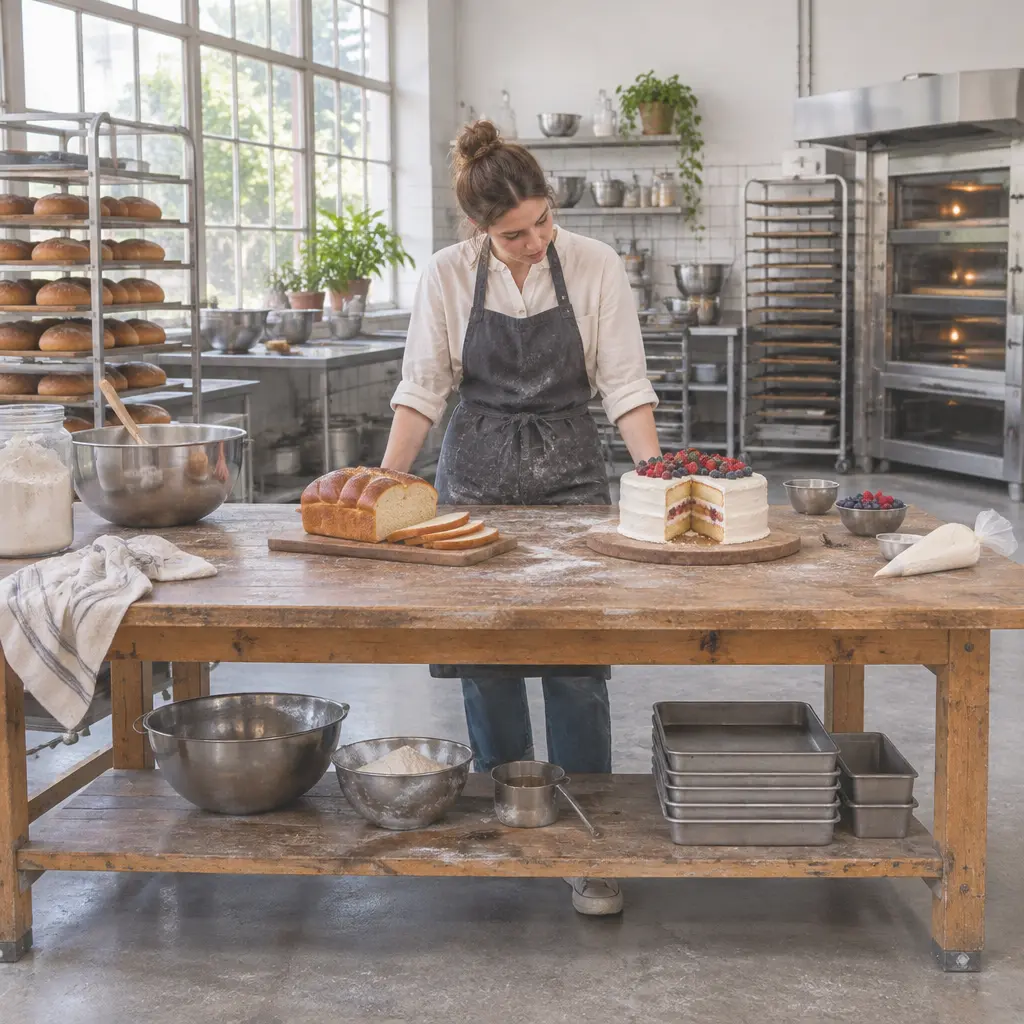
Yeast and Cake Texture: Fermentation, Crumb Density, and What Each Method Creates
Yeast and cake leavening are different ways of making baked goods rise, and the gas-producing method helps shape the finished crumb—the network of holes and walls inside a baked product. Yeast ferments sugars, releasing carbon dioxide that expands within an elastic dough; most cakes instead rely on chemical leaveners such as baking powder, whose quick gas release works alongside air incorporated during mixing. These methods tend to produce different textures: yeast breads are often chewy and openly structured, while cakes are commonly tender and finely porous. The distinction is not absolute, however: recipes, mixing, flour, fat, hydration, and baking conditions also affect density and texture. Understanding those variables helps explain why a cake-like batter cannot simply be treated as bread dough, and why fermentation time matters.
Fermentation and Leavening: How Yeast and Cake Structure Differ
Leavening is the process of introducing or producing gas in dough or batter so that it expands during mixing, fermentation, or baking. The American Society of Baking describes leavening as the creation and expansion of gas cells that contribute to baked-product volume and structure. In yeast dough, baker’s yeast—usually Saccharomyces cerevisiae—metabolizes fermentable sugars and produces carbon dioxide and ethanol. In many cakes, baking powder releases carbon dioxide through chemical reactions, while creaming or whipping incorporates air. Both methods create bubbles, but the timing and composition of the surrounding mixture differ.
A useful comparison is not “yeast always makes dense bread and baking powder always makes light cake.” Instead, compare how each method forms gas, how the batter or dough holds it, and when heat sets the structure. Those interacting factors explain the principal texture patterns and their exceptions.
Yeast fermentation: slow gas production in an elastic dough
Yeast fermentation is the biological conversion of available sugars into carbon dioxide and ethanol, along with other flavor compounds. Carbon dioxide inflates gas cells in the dough; gluten, formed when wheat proteins hydrate and are developed through mixing or kneading, helps retain those cells. Fermentation time and temperature influence gas production and flavor, but a longer rise does not automatically produce a more open crumb: overproofing can weaken dough and cause it to collapse.
Yeast-leavened products include lean breads, enriched breads, rolls, and fermented sweet doughs. Their crumbs vary substantially. A lean, well-developed loaf may have an open, chewy interior, while a tightly shaped sandwich loaf can have a fine, even crumb. Butter, sugar, eggs, and other enriching ingredients can soften dough and affect fermentation, so “yeast texture” is not a single fixed result.
Cake leavening: chemical gas and mechanically incorporated air
Chemical leavening uses an acid-base reaction to release carbon dioxide. Baking powder generally contains sodium bicarbonate and one or more dry acids; depending on the formulation, gas may be released when liquid is added, when the mixture is heated, or in both stages. The American Chemical Society explains that sodium bicarbonate reacts with acids to produce carbon dioxide, which expands bubbles in batter. Cake methods may also trap air by beating sugar with fat or whipping eggs, creating additional nuclei for expansion.
Common examples include butter cakes, sponge cakes, and quick cakes or muffins. Their textures depend on method: creamed cakes can be tender and evenly aerated, while foam cakes rely heavily on whipped eggs for volume. Chemical leavener, mixing, and the batter’s ability to hold bubbles all contribute; using more baking powder than a formula requires can create coarse cells or a collapsed center rather than a reliably lighter cake.
Crumb Density: What the Interior Reveals About Gas and Structure
Crumb density describes how compact or open the baked interior appears and feels. It is related to, but not identical with, measured product density: a loaf’s mass divided by its volume is a quantitative measure, whereas “tight crumb” or “open crumb” often describes the size and distribution of its pores. Researchers can assess bread structure through loaf volume, specific volume, image analysis, and instrumental texture measurements. In practical baking, an even crumb is often desirable in sandwich bread and many cakes, while large irregular holes may be welcome in artisan bread but undesirable in a fine-crumb cake.
Gas-cell size and crumb uniformity
Gas cells are the bubbles that expand during proofing or baking and leave pores after the structure sets. Their size and distribution depend on how bubbles are introduced, how they grow, and whether the surrounding dough or batter can retain them. Yeast dough often begins with air incorporated during mixing and gains carbon dioxide during fermentation; cake batter may contain air from creaming or egg whipping as well as gas from baking powder. A fine, uniform crumb results when cells expand relatively evenly and the structure sets without excessive coalescence or collapse.
For a visual comparison, an image-analysis chart could show pore-size distribution in a sandwich loaf, an open-crumb artisan loaf, and a butter cake. Such a chart would illustrate why overall “lightness” does not mean identical internal structure: a cake may be soft with many small pores, while a rustic loaf can be light in weight yet contain fewer, larger openings.
Gluten, starch, eggs, and fat: the bubble-supporting framework
The gas-producing agent cannot determine texture on its own; the mixture must support bubbles until heat sets the product. In wheat bread, hydrated gluten proteins provide extensibility and strength. In cake, egg proteins and flour structure contribute support, while sugar and fat influence tenderness and the way air is incorporated and retained. Starch gelatinizes as it heats, and proteins coagulate, helping turn an expanding foam or dough into a stable crumb.
This explains why bread flour, cake flour, mixing intensity, and ingredient ratios matter. Stronger gluten development can support a chewy bread structure, whereas excessive development in many cakes can produce a tougher result. Conversely, a high-fat or high-sugar enriched dough may have a softer crumb than a lean loaf, even though both rely on yeast.
Moisture, proofing, and baking conditions
Hydration affects how readily dough stretches and how its gas cells expand. Proofing determines how far yeast dough ferments before baking; underproofed dough may have limited volume and a tight crumb, while overproofed dough may lose strength. Cake batter also depends on accurate ingredient measurement and prompt baking after mixing when its leavener begins reacting. Oven temperature and baking time matter in both cases because the internal structure must set as expanding gases enlarge the cells.
For reliable results, bakers should follow the recipe’s intended method, measure ingredients consistently, and judge dough readiness by its condition rather than time alone. A change in pan size, altitude, or oven behavior can alter baking and expansion, so a recipe developed for one setup may need testing in another.
Yeast Versus Cake Texture: Practical Comparisons and Applications
The main practical distinction is process. Yeast dough usually requires fermentation and proofing, giving time for gas production and flavor development. Cake batter is generally mixed and baked without a prolonged fermentation stage, so chemical leavening and incorporated air provide expansion on a shorter schedule. These differences guide recipe choice, production planning, and troubleshooting.
When a chewy or open crumb is the goal
A yeast-based bread is appropriate when the desired result includes fermented flavor, a resilient bite, or a crumb shaped by dough development and proofing. For example, a baker seeking a sliceable sandwich loaf may aim for a uniform, fine crumb through consistent shaping and proofing; an artisan baker may favor larger, irregular pores through a different dough and handling approach. Neither outcome is guaranteed by yeast alone—the formula and technique determine how fermentation translates into texture.
When a tender, fine crumb is the goal
A conventional chemically leavened cake is generally better suited to a tender, finely aerated crumb. Proper creaming or egg whipping, accurate leavener measurement, and avoiding unnecessary mixing help preserve the intended texture. A yeast-raised cake or sweet bread is also possible, but it follows a fermentation process and often has a more bread-like structure than a standard cake. The label alone is less informative than the recipe’s ingredients and method.
Troubleshooting dense or coarse results
A dense yeast loaf can result from insufficient fermentation, weak dough development, poor gas retention, or an unsuitable balance of ingredients. A dense cake may reflect inaccurate measuring, expired or poorly distributed leavener, inadequate aeration, or batter that was mixed or handled in a way that compromised its bubbles. Coarse holes can arise when gas cells grow unevenly or merge; a sunken center can indicate that the structure failed to set or could not support its expansion. These are diagnostic possibilities, not one-size-fits-all explanations, so checking the formula and process step by step is more effective than simply adding more leavener.
Conclusion: Match the Leavening Method to the Desired Crumb
Yeast fermentation and cake leavening create gas through different routes: yeast produces carbon dioxide biologically over time, while baking powder releases it through chemical reactions, often alongside air incorporated during mixing. Crumb density and texture then emerge from the gas cells, the dough or batter’s supporting structure, ingredient ratios, fermentation or mixing, and baking conditions. Yeast breads can be fine or open; cakes can be tender or coarse, depending on their formulation and handling.
For a practical next step, compare a yeast loaf and a chemically leavened cake by recording their formulas, mixing methods, rise or resting times, baked volume, and crumb appearance. That simple comparison makes the connection between leavening and texture visible—and helps you choose a method based on the crumb you actually want.
Sources: American Society of Baking, “Leavening,” https://asbe.org/article/leavening/; American Chemical Society, “Baking Powder,” https://www.acs.org/education/whatischemistry/landmarks/baking-powder.html; Cauvain, Stanley P., and Linda S. Young, Technology of Breadmaking, Springer, https://doi.org/10.1007/978-3-319-14687-4; Pyler, E. J., and L. A. Gorton, Baking Science & Technology, Sosland Publishing.