
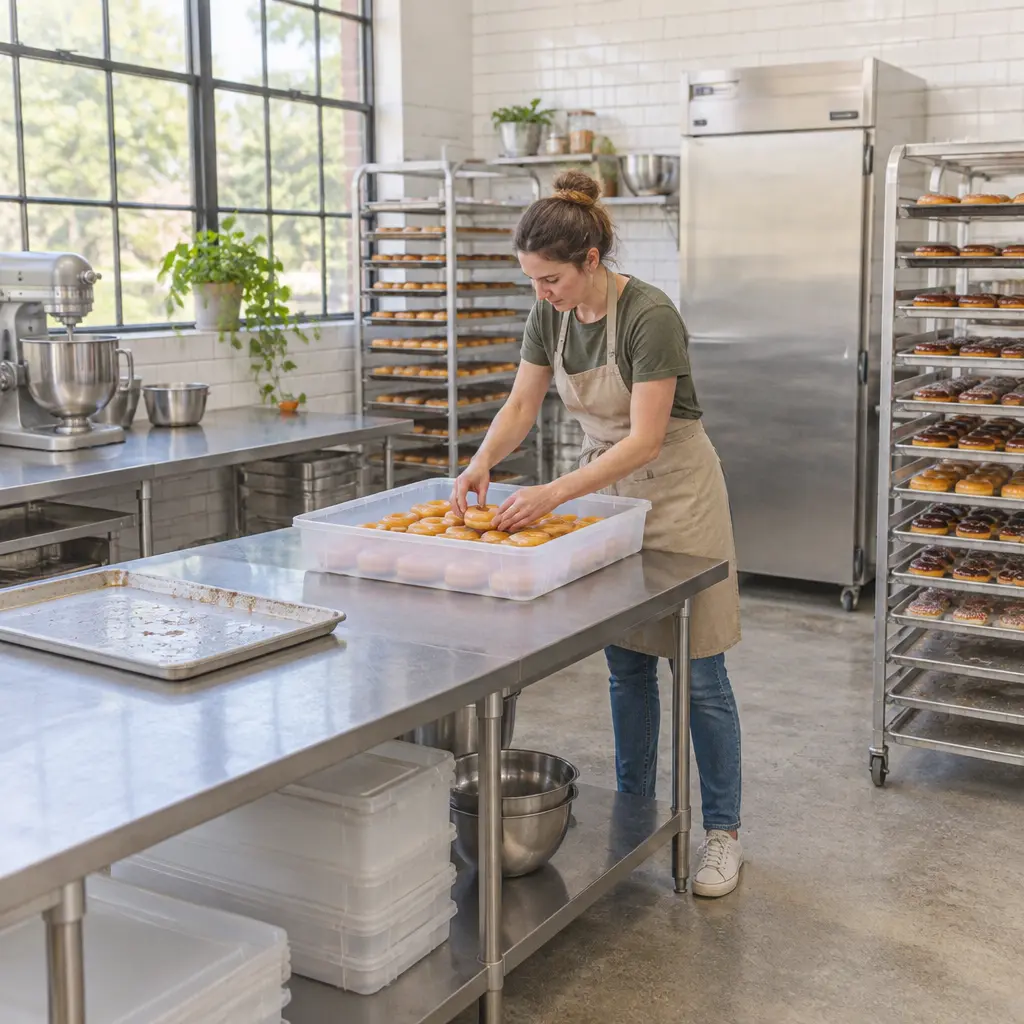
Fresh donuts lose their just-made texture when moisture moves, escapes, or condenses in the wrong place. A warm donut sealed in a bag can turn clammy; a refrigerated one can become firm; and an exposed one can dry out. The best short-term approach is to let donuts cool completely, keep them in a closed container at room temperature, and eat them as soon as practical—often the same day. These storage mistakes matter because donuts are porous, moisture-sensitive foods, and even hours of poor handling can soften a crisp exterior or toughen a tender crumb.
Donut texture depends on moisture, temperature, and packaging
Donut texture is the combined feel of its crust, crumb, and coating: it may be crisp or tender, airy or dense, moist or dry. Food-science literature describes staling as a quality change involving moisture redistribution and starch retrogradation, in which starch molecules reorganize after baking or frying. This is different from simple drying, though both can make a donut seem less fresh.
The exact storage life varies with recipe, size, filling, glaze, and room conditions, so there is no reliable universal “fresh for X hours” figure. The practical goal is to slow moisture loss without trapping condensation. Donuts are best treated as short-lived baked goods, not as products that improve with prolonged storage.
Cake donuts and yeast-raised donuts
Cake donuts use chemical leavening and generally have a tighter, more cake-like crumb; yeast-raised donuts rely on fermentation and tend to be lighter and more open. Their different structures affect how they respond to drying and compression. A paper bag may protect a donut from dust but allows moisture to escape, while a tightly closed container limits drying but can trap moisture from a warm donut.
Glazed, sugared, and filled varieties
A glaze, sugar coating, or filling adds another moisture-sensitive layer. Humidity can make granulated sugar damp and sticky; condensation can dissolve or streak a glaze. Cream-, custard-, or other perishable-filled donuts require a different priority: food safety comes before ideal texture. The U.S. Department of Agriculture advises that perishable food should not remain at room temperature for more than two hours, or one hour when the temperature is above 90°F (32°C). Follow the bakery’s storage directions when they are stricter.
Storage mistakes that quietly ruin fresh-donut texture
Most texture damage comes from choosing packaging or temperature without considering whether the donut is still warm, whether the air is humid, and whether the filling is perishable. The following mistakes are common because they seem convenient but accelerate either moisture loss, condensation, or firming.
Sealing donuts while they are still warm
Warm donuts release water vapor. If they go straight into a sealed bag or container, that vapor can condense on the lid and return to the surface as droplets. The coating becomes tacky, and the outer layer may turn soft or greasy. Let donuts cool on a rack until they are no longer warm before covering them; avoid leaving them uncovered for so long that they dry out.
Leaving donuts exposed to air
An open box, plate, or loosely folded bag allows moisture to escape. The surface dries first, while the interior may remain softer, creating a tougher or stale-feeling bite. Once fully cool, place plain or glazed donuts in a clean, airtight container at room temperature and keep the container away from sunlight, heat, and strong odors.
Refrigerating ordinary donuts by default
Refrigeration can make many breads and baked goods firm faster because low temperatures promote starch retrogradation. For plain, glazed, or sugar-coated donuts, refrigeration is usually not the best way to preserve softness if they will be eaten soon. Filled donuts containing ingredients that require refrigeration are the exception: refrigerate them promptly according to the seller’s instructions, accepting that the texture may change.
Using the wrong bag or container
Paper packaging breathes and can help prevent a freshly fried surface from feeling trapped, but it also lets donuts dry out. Plastic or airtight packaging slows moisture loss but can make a warm or humid donut sticky. A practical compromise is to cool the donuts fully, then store them in a closed container; separate layers with parchment if needed to prevent toppings from sticking.
Stacking or crowding donuts
Stacking can flatten soft tops, smear icing, and press moisture into neighboring surfaces. Donuts crowded together also have less space for residual heat to dissipate. Store them in a single layer when possible. If space is limited, use parchment between layers and avoid placing heavy items on top.
Freezing without wrapping properly
Freezing is useful for longer storage, but exposed donuts can develop freezer burn and absorb odors. The USDA explains that food kept continuously frozen remains safe indefinitely, although quality declines over time. For better quality, wrap cooled donuts individually or in small portions, place them in a freezer-safe airtight package, and thaw while still wrapped to reduce condensation on the surface.
A practical storage routine for better texture
A simple routine prevents most avoidable damage: identify whether the filling is perishable, cool the donuts, choose packaging based on the intended storage period, and avoid repeated temperature changes. For best texture, buy or serve only what can be eaten soon; storage can slow quality loss, but it cannot restore a fresh-fried crust or newly set glaze.
- Separate perishable-filled donuts from plain or shelf-stable varieties and follow the bakery’s refrigeration directions.
- Let warm donuts cool fully on a rack before covering them.
- For short-term storage, keep nonperishable donuts in a closed container at room temperature, away from heat and direct sunlight.
- For longer storage, freeze them well wrapped; thaw at room temperature while wrapped, then unwrap once condensation risk has passed.
- Discard food that has been held unsafely or shows signs of spoilage; smell and appearance alone cannot reliably establish food safety.
A useful visual guide would compare three outcomes: an exposed donut losing moisture, a warm sealed donut collecting condensation, and a cooled donut stored in a closed container. The comparison illustrates the central trade-off: prevent drying, but do not trap steam.
Conclusion: protect freshness without trapping moisture
Fresh-donut texture is most often compromised by sealing donuts while warm, leaving them exposed, refrigerating ordinary varieties unnecessarily, or crowding them together. Cool them before storage, use a closed room-temperature container for short-term keeping, and refrigerate perishable fillings according to food-safety guidance. Freeze properly wrapped donuts when longer storage is necessary. For the best result, enjoy them promptly and treat storage as a way to slow decline—not a substitute for freshness.
Sources: USDA Food Safety and Inspection Service, Leftovers and Food Safety, https://www.fsis.usda.gov/food-safety/safe-food-handling-and-preparation/food-safety-basics/leftovers-and-food-safety; USDA Food Safety and Inspection Service, Freezing and Food Safety, https://www.fsis.usda.gov/food-safety/safe-food-handling-and-preparation/food-safety-basics/freezing-and-food-safety; Gray, J. A., and Bemiller, J. N., Bread Staling: Molecular Basis and Control, Comprehensive Reviews in Food Science and Food Safety, 2003, https://doi.org/10.1111/j.1541-4337.2003.tb00011.x.