
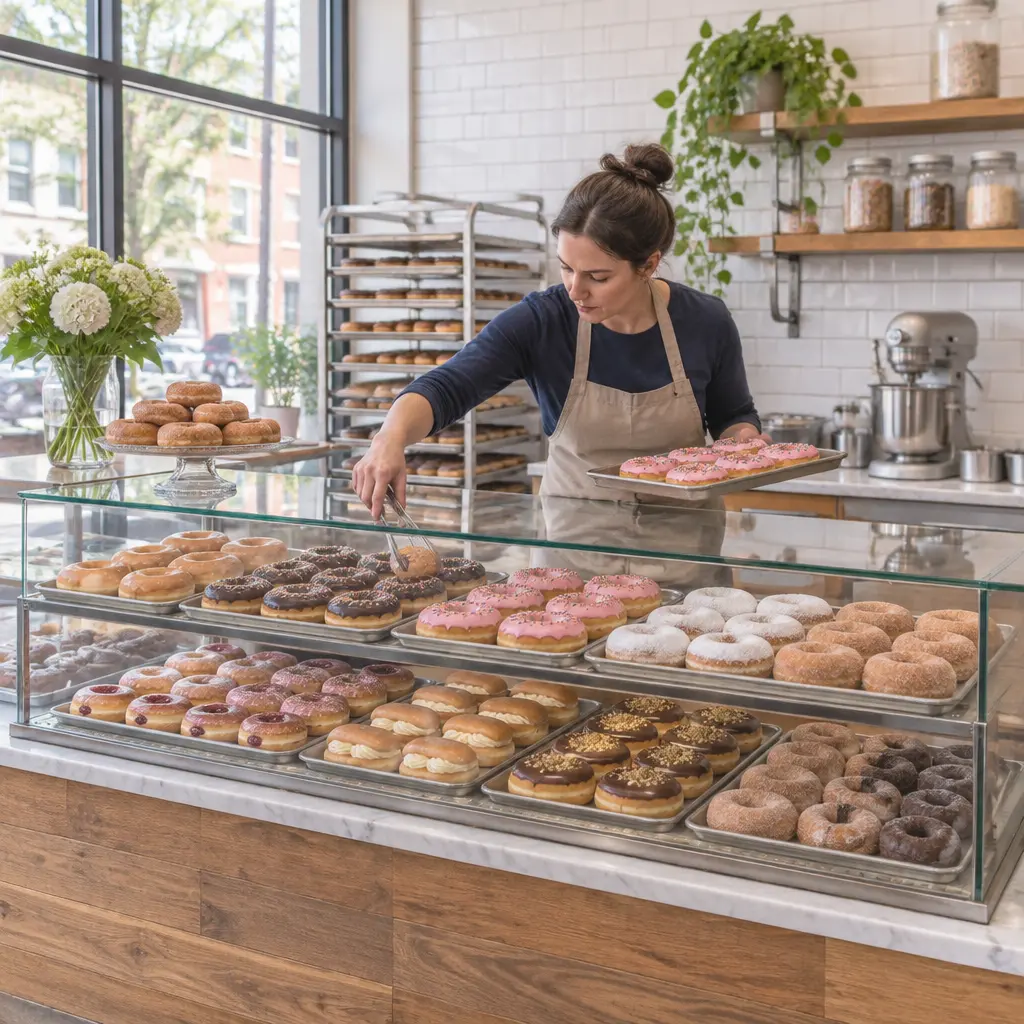
A donut’s texture is the way its dough feels and behaves when bitten, while its filling is the sweet or savory center enclosed within it. Together, these features often shape the eating experience more than toppings do: a crisp edge, airy crumb, or flowing custard changes each bite, whereas a glaze or sprinkle mainly changes the surface. The distinction is practical as well as sensory—donut styles depend on different doughs and cooking methods, and fillings bring their own contrasts in moisture, richness, and flavor. Understanding those choices helps explain why a plain, well-made donut can be more memorable than an elaborate topping-covered one.
Donut texture defines the bite before toppings do
Texture is the combined sensation of a food’s structure in the mouth: softness, firmness, chewiness, airiness, and crispness. Food scientists commonly describe texture through properties such as hardness, cohesiveness, and springiness. For donuts, these properties arise from ingredients and processing—especially flour, leavening, mixing, proofing, frying, and cooling—not simply from decoration.
The American Association of Cereal Chemists International (AACC International), now known as Cereals & Grains Association, treats texture as a measurable quality of cereal foods, including baked products. A donut’s crumb can be examined for pore size and distribution, while a bite test reveals how easily it compresses and springs back. In everyday terms, a diner distinguishes a light yeast-raised ring from a dense cake donut immediately, even before noticing whether either has a glaze.
Yeast-raised donuts: airy crumb and elastic chew
A yeast-raised donut is made with dough leavened by yeast. Fermentation produces carbon dioxide, which expands the dough and creates a network of small gas cells. When fried, that structure becomes a tender, airy interior beneath a delicate exterior. A properly made example feels light but still has enough elasticity to resist the bite slightly.
The texture depends on fermentation and handling. Underproofing can leave a tight, heavy crumb; overproofing can make a donut fragile or prone to collapsing. Flour strength also matters: gluten gives the dough its stretch and capacity to hold gas. These structural differences explain why a simple sugar-dusted yeast donut can feel more satisfying than a heavily decorated one with a less balanced interior.
Cake donuts: a compact, tender crumb
A cake donut is typically leavened with baking powder or another chemical leavener rather than yeast. Its crumb is generally more compact and uniform, with a soft, slightly crumbly or pleasantly firm bite. The category includes plain rings, old-fashioned styles with irregular edges, and many molded or cut shapes.
Because chemical leavening acts during mixing and cooking, cake donuts do not develop the same fermented structure as yeast-raised donuts. Their texture can be especially responsive to fat, sugar, and moisture in the batter. A tender cake donut may carry a thin glaze well, while a denser version can stand up to a thicker coating without losing its shape. The contrast is useful: toppings may complement the crumb, but they cannot turn a dry, tight interior into a tender one.
Crust, frying, and freshness
The crust is the browned outer layer formed during frying. Heat causes moisture near the surface to escape and encourages browning reactions, producing a slight crispness and toasted flavor. The goal is usually contrast rather than a hard shell: a thin exterior surrounding a soft center.
Frying conditions influence that balance. Oil that is too cool can leave a donut greasy, while excessive heat can brown the outside before the center cooks through. The U.S. Department of Agriculture’s FoodData Central lists substantial variation in the energy and nutrient composition of donuts by product type and serving, a reminder that recipes and preparation methods differ. For diners, freshness is often the more immediate measure: as a donut sits, moisture moves through its crumb and crust, changing softness and crispness. A chart comparing yeast-raised and cake donuts could show texture along dimensions such as airiness, chew, and density; it would make clear that “soft” is not one single quality.
Donut fillings create contrast and flavor through the center
A donut filling is an ingredient or mixture placed inside the dough, usually after frying or baking. It may be piped into a finished donut, layered into a shaped dough before cooking, or enclosed within a sealed pastry-style form. Fillings change more than flavor: they add moisture, weight, temperature contrast, and a different texture within the crumb.
The main filling families include fruit preserves, custards and creams, chocolate-based mixtures, and savory preparations. Each behaves differently. A jam may bring acidity and a smooth, sticky consistency; pastry cream offers richness and a cool, soft center; a thick chocolate filling adds density. Because fillings are often concentrated in one area, their distribution matters: an unevenly filled donut can alternate between an empty bite and an overwhelming one.
Fruit preserves: sweetness balanced by acidity
Fruit preserves are cooked fruit mixtures, often made with sugar and sometimes pectin, used as a donut center. Raspberry, strawberry, and apple are familiar choices. Their defining sensory feature is the balance between sweetness and fruit acidity, which can keep a rich fried dough from tasting flat.
The National Center for Home Food Preservation explains that sugar and acidity contribute to the preservation and setting of many fruit products. Commercial donut fillings are formulated for consistency and production, but the same basic qualities influence the eating experience: a thicker preserve stays in place, while a looser one feels juicier and may soak into the crumb. A fruit-filled donut pairs especially well with a neutral or lightly sweet dough because the center remains distinct.
Custard and cream: smooth, rich centers
Custard fillings are mixtures thickened with eggs, starch, or both; pastry cream is a common example, often flavored with vanilla. Cream fillings may also be made with whipped or stabilized components. Their soft, smooth texture contrasts with the dough’s porous crumb, making the center feel particularly rich.
Food safety matters because many custard and cream fillings contain perishable ingredients. The U.S. Food and Drug Administration advises keeping foods that require refrigeration out of the temperature danger zone, generally 40°F to 140°F (4°C to 60°C), and following safe storage and handling practices. This is one reason filled donuts are best stored and displayed according to the bakery’s guidance rather than treated like shelf-stable glazed rings.
Chocolate and other dense fillings
Chocolate fillings range from soft ganache to thicker chocolate creams. They deliver concentrated cocoa flavor and a dense, smooth sensation that can make a donut feel more substantial. Other options, including nut pastes and caramel, also create a richer center and can add a sticky or fudgy quality.
The success of a dense filling depends on proportion. Too little can disappear into the dough; too much can overwhelm its structure or make the donut difficult to handle. Bakers often choose a sturdy yeast-raised dough for injection fillings because its interior can hold a pocket without becoming excessively fragile. In this sense, filling and texture are a matched pair: the dough must support the center while still allowing it to be noticed.
Texture and filling work together more deeply than toppings
A topping is usually an exterior addition—such as glaze, icing, sugar, nuts, or sprinkles—while texture and filling shape the donut’s structure and interior. Toppings can add a first impression of sweetness, crunch, or color, but the dough determines how the bite yields, and the filling determines what the center contributes. The eating experience is therefore built from multiple layers: crust, crumb, and, when present, filling.
The contrast can be seen in familiar examples. A plain old-fashioned cake donut has a distinctive craggy crust and compact crumb even without icing. A jelly donut relies on the difference between soft dough and tart, moist fruit. A cream-filled ring combines an airy structure with a smooth center. In each case, removing the topping would leave the defining experience largely intact; removing or changing the texture or filling would transform it.
How to choose a donut by sensory preference
Choosing by texture and filling is more useful than choosing by appearance alone. Consider these pairings:
- A light, elastic bite: choose a yeast-raised donut, plain or lightly glazed.
- A more compact, tender bite: choose a cake donut, with or without a thin coating.
- A bright, fruit-forward center: choose a preserve-filled donut, such as raspberry or apple.
- A smooth, rich center: choose custard, pastry cream, or chocolate filling, and check storage guidance.
- A crisp-sweet surface: choose a fresh donut with a lightly browned crust rather than relying on a thick topping to supply texture.
For a bakery tasting, compare donuts without strong toppings first, then sample the same dough with a filling or coating. A simple tasting chart could record crust crispness, crumb airiness, chew, filling distribution, sweetness, and aftertaste. This helps separate the effect of the dough from the effect of decoration and makes comparisons more informative.
Conclusion: the center and crumb make the lasting impression
Donut texture defines the first bite through airiness, density, chew, and crust, while fillings add moisture, richness, acidity, or smoothness at the center. Yeast-raised and cake donuts offer distinct structures; fruit preserves, custards, creams, and chocolate bring different kinds of contrast. Toppings remain enjoyable, but they are only one layer of a product whose deeper character comes from dough and filling.
Next time you choose a donut, notice its crumb and center before judging its decoration. Comparing a plain yeast-raised donut with a cake donut, or tasting fruit and cream fillings side by side, offers a clearer sense of how baking technique and ingredient choices shape the experience.
Sources: AACC International (Cereals & Grains Association), Cereal Science and Technology resources, https://www.cerealsgrains.org/; U.S. Department of Agriculture, FoodData Central, https://fdc.nal.usda.gov/; National Center for Home Food Preservation, Preserving Food: Jams and Jellies, https://nchfp.uga.edu/how/make-jam-jelly/; U.S. Food and Drug Administration, Food Safety at Home, https://www.fda.gov/consumers/consumer-updates/food-safety-home.